





News & Stories.
 02 July 2026
Biking in Zugarramurdi Witches, Legends and Pacts with the Devil
Some places are simply visited.
Others are truly experienced.
Zugarramurdi belongs to that rare group of destinations capable of capturing your imagination long before the ride even begins. A small village in northern Navarra, just a few kilometres from the French border, where nature and history have been intertwined for centuries.
Known worldwide for the legendary Witches of Zugarramurdi and one of the most infamous witch trials in Spanish history, this corner of the Xareta Valley is far more than a place of myths and legends. It is also one of the most unique mountain biking destinations in the Atlantic Pyrenees.
My adventure begins in the narrow stone streets of the village before quickly leaving the pavement behind and entering a landscape unlike almost anywhere else in Spain. Dry scenery gives way to vast Atlantic forests dominated by ancient oak, beech and chestnut trees. Moss blankets every rock, giant ferns line the trails, and the constant humidity creates an atmosphere that feels almost magical.
From the very first metres, the route makes one thing clear: this is no easy ride. Narrow singletracks, slippery roots, wet rocks and relentless elevation changes turn the trail into a paradise for technical mountain biking. Every corner demands complete focus, yet every metre rewards you with an incredible sense of adventure.
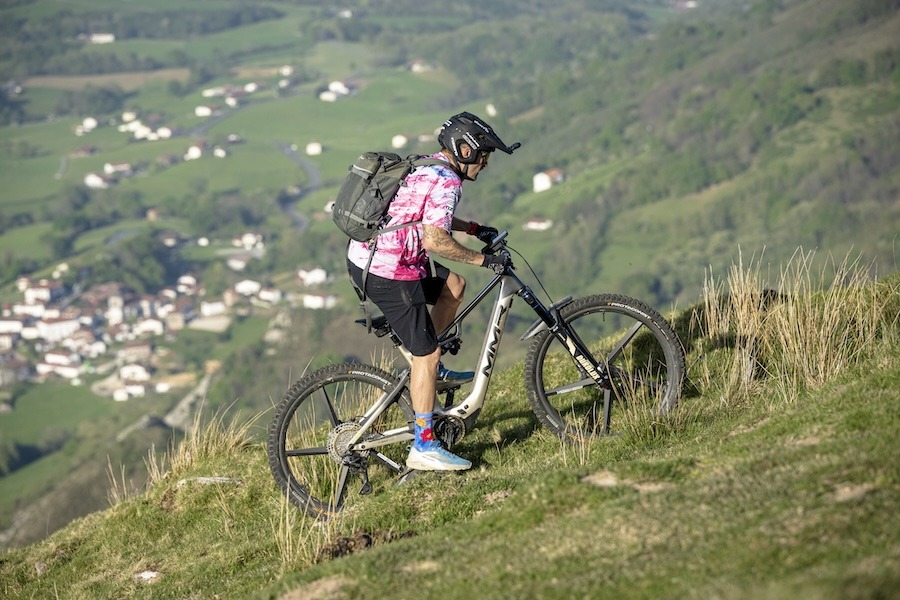
As the climb continues, the scenery gradually changes. Dense woodland gives way to wide open meadows where the first views towards France begin to appear. The Atlantic Pyrenees reveal a very different personality from the rugged alpine landscapes many people associate with the mountain range. Rather than dramatic cliffs, the terrain is shaped by endless rolling green hills sculpted over thousands of years by rain, wind and the Atlantic climate that defines the entire region.
For centuries these mountains were far more than a natural border. Shepherds, merchants and smugglers followed these very same paths, crossing between Spain and France carrying tobacco, food, tools and other goods at a time when the mountains represented both a frontier and an essential route of communication.
Wildlife accompanies the ride throughout the day. Horses and cattle graze freely across the hillsides while griffon vultures circle silently above the rising thermals. Everything here conveys a remarkable feeling of peace that is becoming increasingly rare to find.
But if there is one thing that truly makes Zugarramurdi unique, it is its history.
At the beginning of the 17th century, fear and superstition led to one of the largest witch trials in Spanish history. Dozens of local residents were accused of participating in alleged witches’ gatherings held inside the nearby caves. Many were arrested, tried and executed during what is now remembered as one of the darkest episodes of the Spanish Inquisition.
Today, the Witches’ Museum preserves the memory of those events through a historical and human perspective, helping visitors understand how fear was capable of transforming an entire community.
Just a short walk from the museum lie the famous Zugarramurdi Caves. A spectacular natural tunnel carved by water over thousands of years and crossed by a small stream known as the Hell’s Brook. It is a place where geology, history and folklore come together to create one of Navarra’s most extraordinary natural landmarks.
Yet Zugarramurdi is also discovered through its culture and gastronomy. Livestock farming remains an essential part of everyday life in the valley, with the native Latxa sheep producing the milk used to make the renowned Idiazabal cheese. Traditional dishes such as txistorra sausage, roast lamb, beans, wild mushrooms and hearty mountain stews perfectly reflect the culinary identity of this remarkable region.
After riding these trails, it becomes easy to understand why this small corner of northern Spain has inspired films, novels and documentaries for decades. Nature, history, culture and mountain biking come together here in a way that very few destinations can offer.
Zugarramurdi proves that a mountain bike ride can become so much more than simply another day on the bike. It becomes a journey through landscapes, history and traditions, where every forest, every trail and every stone seems to hold a story waiting to be discovered.
Because in the end, that’s exactly what I love most about travelling by bike.
It’s never just about covering kilometres.
It’s about discovering places that stay with you long after you’ve stopped pedalling.
Words & Riding: David Cachón
Photography: Ismael Ibáñez
Share article