





News & Stories.
 07 October 2026
Aínsa: chasing the legend of Basa de la Mora
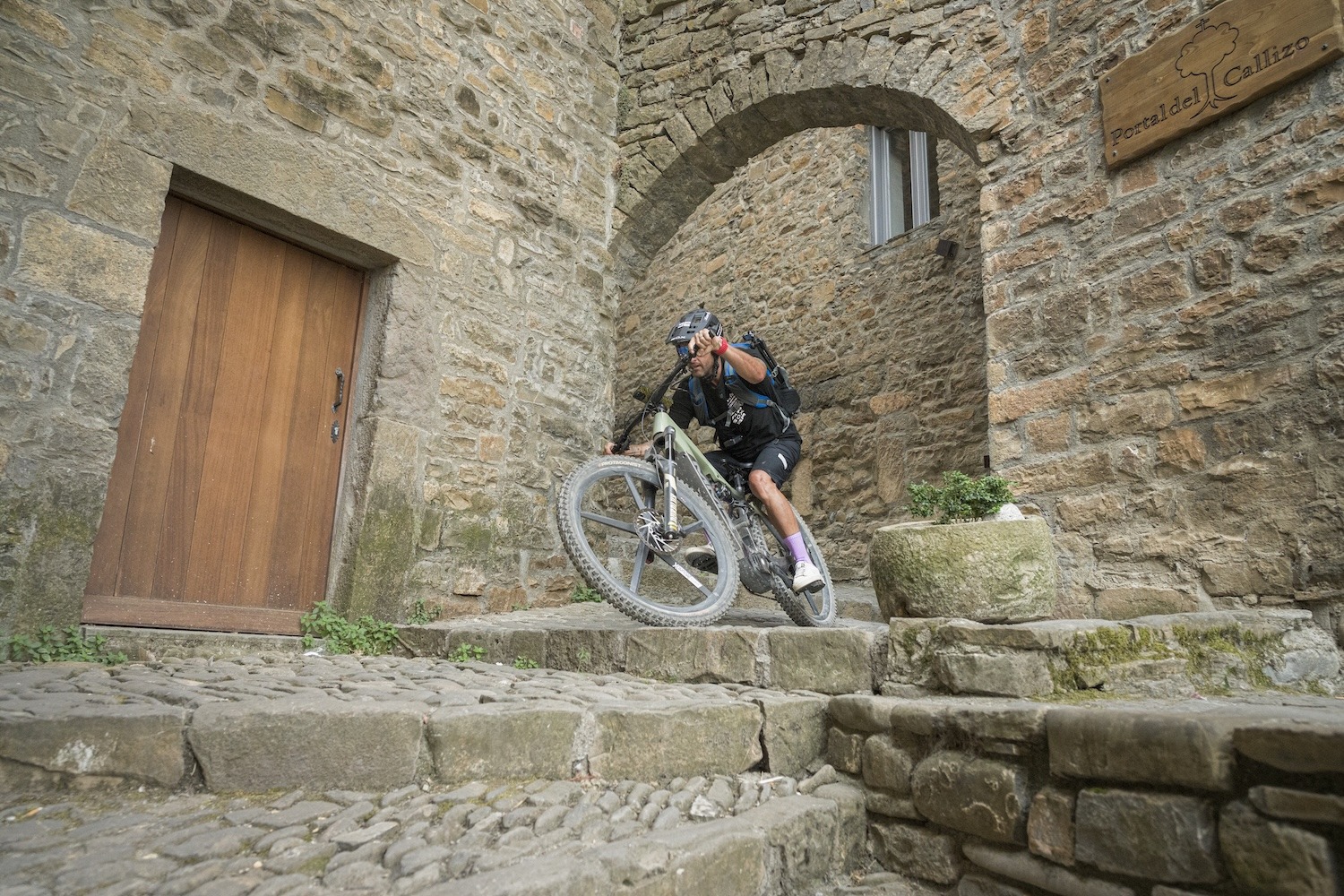
A medieval village, ancient trails brought back to life, more than 1,000 metres of climbing and a hidden mountain lake surrounded by a mysterious legend passed down through generations. This time, I travelled to Aínsa to discover why this corner of the Pyrenees has become one of Europe’s great mountain bike destinations—and, along the way, to try to reach one of the most magical places in Sobrarbe by bike: Ibón de Plan.
I had been hearing about Aínsa for years. It didn’t matter whether I was talking to Spanish, French, British, German or Italian riders; whenever the conversation turned to the best places in Europe to ride a mountain bike, sooner or later the same name would come up: Aínsa. And when a place builds that kind of reputation, curiosity inevitably follows. How much of it is real, and how much is myth? So this time I loaded up the bike and headed towards the Aragonese Pyrenees to find out for myself.
But I wanted to do it my way. I hadn’t travelled all this way simply to link together trails, collect kilometres or search for the most spectacular descent. What I really wanted was to use the bike as an excuse to explore the territory, discover its history and eventually reach one of those places whose name already sparks curiosity before you have even seen it: Ibón de Plan, also known as Basa de la Mora.
And to get there, this story had to begin in Aínsa.
WHERE THE LEGENDS BEGIN BEFORE YOU EVEN GET ON THE BIKE
Some villages are simply starting points. Others make you forget, at least for a while, that you came there to ride. Aínsa definitely belongs to the second group. Its historic old town overlooks the confluence of the Ara and Cinca rivers and has somehow preserved the feeling of a place that has resisted the passage of time. The Plaza Mayor, castle, medieval walls, arcades and narrow stone streets make walking through Aínsa feel almost like stepping through a doorway into another era.
Aínsa is also one of those places where history and legend are difficult to separate. One of its best-known stories takes us back to the year 724, when, according to tradition, a cross of fire appeared above a holm oak during a battle between Christians and Muslims. The vision is said to have inspired the Christian troops and helped lead them to victory. Centuries later, the cross and the tree remain part of Aínsa’s coat of arms.
I like starting my journeys this way, trying to understand what existed in these places long before we arrived with our bikes, helmets, cameras and GPS devices. Because, interestingly enough, much of what makes Aínsa such an extraordinary mountain bike destination today has its origins in the past.
ZONA ZERO: RECOVERING THE PAST TO BUILD THE FUTURE
If thousands of riders now travel to Aínsa every year, much of the credit goes to Zona Zero. And what I find most fascinating about its story is that many of the trails that have turned this region into an international MTB destination were never built for mountain bikes.
Quite the opposite.
They are old paths used for generations by shepherds, farmers and the inhabitants of Sobrarbe’s small mountain villages. They were routes to reach pastures, connect communities, work and simply live in this rugged landscape.
As traditional uses gradually disappeared, many of those paths became abandoned and vegetation began to reclaim them. Then a group of passionate locals decided to reverse the process: clearing the trails, recovering them and bringing them back to life.
That was the beginning of Zona Zero.
What started as a local initiative eventually developed into a huge network of routes and trails that has placed Aínsa firmly on the international mountain bike map.
But reducing Zona Zero to its trails would mean missing a huge part of the story. Mountain biking has created activity throughout the region: accommodation, bike shops, workshops, restaurants, guides and businesses directly or indirectly connected to cycling. Spend a little time sitting on a terrace in Aínsa and you will see it everywhere. Bikes leaning against walls, vans loaded with equipment, groups of riders planning the next day’s route and conversations in different languages that nearly always end up discussing the same things: mountains and trails.
Here, mountain biking does not feel like something that has simply been added to the destination.
It has become part of it.
And after understanding a little more about the story behind Zona Zero, it was time to stop talking and start pedalling.
IN SEARCH OF BASA DE LA MORA
For this adventure I chose one of the area’s most iconic routes, ZE001, leading towards Ibón de Plan. Ahead of me were approximately 23 kilometres and more than 1,000 metres of elevation gain. The distance might sound relatively friendly until you notice that second figure, because almost all of that climbing is packed into a long ascent beginning near Saravillo, in the Chistau Valley.
The first few kilometres allow you to settle into a relatively comfortable rhythm, but gradually the mountain begins to reveal its hand. The valley drops farther below, the air becomes cooler and the landscape changes almost without you noticing. The track disappears into the forest and eventually you reach one of my favourite moments on this kind of adventure: the noise disappears, and for long stretches all you can hear is your own breathing, the drivetrain and the tyres rolling over the ground.
We are deep in Sobrarbe, surrounded by some of the most spectacular landscapes in the Aragonese Pyrenees and very close to Ordesa y Monte Perdido National Park. This is a territory shaped over thousands of years by ice, water and erosion. Ancient glaciers carved enormous valleys and created much of the landscape we now cross on our bikes. And although it is easy to become completely focused on the next few metres of trail, every now and then it is worth looking up. These forests and mountains are home to roe deer, wild boar, foxes, griffon vultures and the legendary bearded vulture, one of the great symbols of the Pyrenees.
As I gained altitude, another thought kept returning to me: many of the paths beneath my tyres had existed for centuries before anyone could have imagined a mountain bike. We are simply the latest arrivals. In the past, these trails were used to move livestock, connect villages or reach high mountain pastures. Today, thanks to their recovery, they are alive once again. That connection between past and present is one of the things I find most fascinating about exploring a territory by bike.
The climb continues until reaching the Lavasar refuge. From there, the adventure changes considerably. The terrain becomes more difficult, rocks take over and eventually insisting on staying on the bike stops making much sense. Time to get off, push and continue on foot through some sections.
It might not be the part of the adventure that usually makes it into the most spectacular Instagram photos, but it is part of the experience too. And, more importantly, it makes what comes next feel even more rewarding.
Because after negotiating that final rocky section, the forest eventually opens up and there it is in front of me: the place I have spent hours trying to reach.
Ibón de Plan.
THE LAKE WHERE, THEY SAY, A PRINCESS STILL DANCES
At almost 1,900 metres above sea level, Ibón de Plan is one of those places that seems to demand silence the moment you arrive. Surrounded by an enormous natural amphitheatre of mountains, its waters occupy an ancient glacial basin and create one of the most recognisable landscapes in the Aragonese Pyrenees. After climbing more than 1,000 vertical metres and spending the final section pushing and carrying the bike across the rocks, sitting beside the water feels very different.
But this is not only an extraordinary place from a natural point of view. Ibón de Plan is also known as Basa de la Mora, and one of the best-known legends in these mountains has been passed down around it for generations.
Tradition tells the story of a young Moorish woman who fled to this place during the medieval wars and whose spirit remained forever connected to the lake. Every year, on the night of San Juan, legend says that she appears above the water and begins to dance.
There is, however, one small condition.
Not everyone can see her.
Only those who reach Basa de la Mora with a completely pure heart are able to watch her dance.
I arrived, looked very carefully for quite a while… and saw nobody dancing.
I prefer to believe I simply chose the wrong day.
Joking aside, it is easy to understand why a landscape like this has inspired stories and legends for generations. Some places are spectacular because of what you see; others also have an atmosphere that is much harder to explain. Basa de la Mora has both. The silence, the mountains reflected in the water and the feeling of being completely isolated make the effort required to reach it disappear almost instantly.
Although in my case it was still a little too early to forget about the effort, because exactly half of the adventure remained.
And this time, gravity was finally going to be on my side.
1,000 METRES DOWN
If the climb had allowed me to understand the natural scale of the territory, the descent was about to show me exactly why Zona Zero has earned such a strong reputation among riders from across Europe.
As soon as I began losing altitude, all those ingredients we look for when travelling somewhere with a mountain bike started appearing: natural trails, roots, rocks, linked corners, constantly changing terrain and that wonderful sensation of finishing one turn only to immediately discover the next.
What I loved most was how natural everything felt. The mountain does not seem to have been transformed to accommodate the bicycle; instead, we have to adapt to the mountain. You have to read the terrain, let the bike run when you can, control it when necessary and play with whatever the trail places in front of you. There is no need for enormous jumps or artificial features when the terrain itself offers this much variety.
And then something happens that, for me, perfectly defines a great trail: you stop thinking about how far there is to go.
You simply want it to continue.
At the same time, it is impossible to ride these trails without thinking about the huge amount of work behind them. Trails do not magically appear clean and signposted every morning. Recovering and maintaining them requires time, people and constant coexistence between riders, hikers, livestock farmers and local residents.
As mountain bikers, we have our part to play too: slowing down when passing other people, staying on the trail, closing gates, respecting livestock and leaving absolutely no waste behind. They are simple things, but they help ensure that all of us can continue enjoying places like this.
AÍNSA: MUCH MORE THAN GREAT TRAILS
After completing the descent, I returned to Saravillo, loaded the bike and headed back towards Aínsa. The ride itself had finished, but I wanted to return to the same place where the journey had begun because now I could look at it from a completely different perspective.
Once again I saw bikes leaning against terraces, workshops, bike shops, vans and groups of riders discussing their routes. Only this time I understood much better what lay behind it all.
Aínsa has not become one of Europe’s great mountain bike destinations simply because it has good trails. Great trails can be found in many places. What makes Aínsa different is the way cycling has become integrated into the territory, its economy and the way the region looks towards the future without turning its back on its past.
At the beginning of this journey, I asked myself why riders from around the world travel hundreds, sometimes thousands, of kilometres to reach this small corner of the Pyrenees. After exploring its mountains and finally reaching Basa de la Mora, I think the answer is not hidden in one particular descent, one specific route or even that spectacular lake sitting almost 1,900 metres above sea level.
It is the combination of everything.
It is walking through a medieval village in the morning and, just a few hours later, finding yourself completely alone in the mountains. It is riding paths that had been used for centuries before our bicycles existed. It is discovering that behind every trail there are people working to bring it back to life. It is the history, the legends, the landscapes, the food and, above all, the people who continue to give life to this territory.
For me, that is exactly what travelling by bicycle means. It is not simply about finding the best trail or getting from point A to point B. It is about using the bicycle as a tool to discover everything that exists around the trail.
And perhaps that is the real magic of Aínsa.
I came here searching for one of Europe’s great mountain bike destinations and ended up following ancient paths towards a lake where legend says that, one night every year, a mysterious young woman can still be seen dancing over the water.
I didn’t manage to see her.
But I found more than enough reasons to come back.
Text & riding: David Cachon
Photography: Ismael Ibañez
Share article